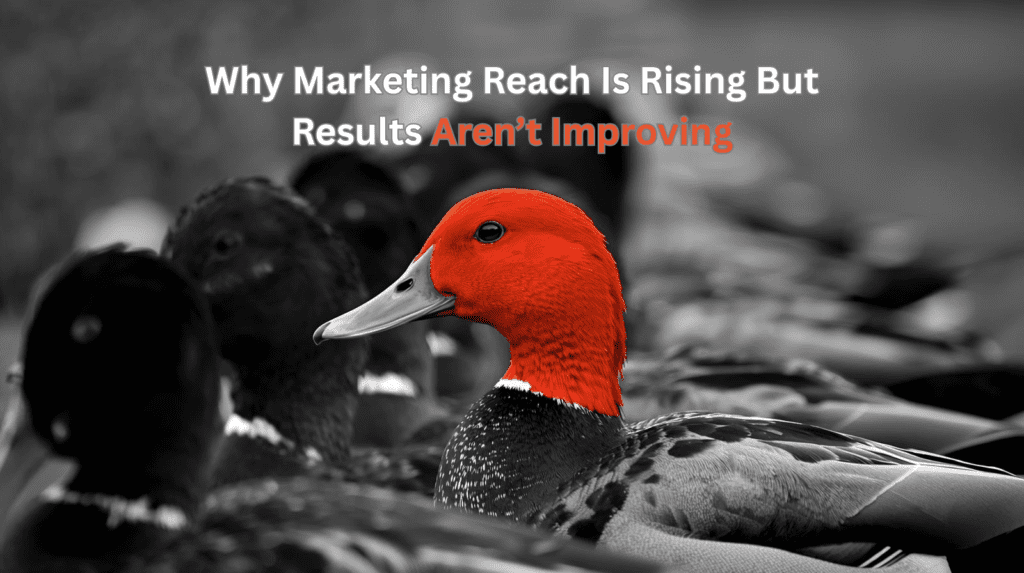
“Our reach is higher now, but we aren’t seeing an uplift in revenue or profitability.”
It’s something I hear all the time in my marketing efficiency work, and I’m willing to bet you’ve felt it too.
Impressions are up.
Engagement is up.
You’re creating more content than ever before.
But leads, conversions, revenue and profitability are static. Or worse, declining. And definitely not increasing at the same rate as your reach.
For many businesses, this shows up as rising customer acquisition costs, flat conversion rates, and marketing teams working harder for the same results.
So you go back and review your marketing.
Maybe the messaging isn’t strong enough.
Maybe the content isn’t engaging enough.
Maybe the answer is simply doing more.
More posts.
More campaigns.
More ads.
More content.
But most people miss the real shift.
The environment changed.
Social feeds no longer show a small set of posts from people you follow.
They show clusters of competing ideas and solutions chosen by algorithms.
Social media hasn’t just become more competitive.
It has become structurally more competitive.
Reach Used To Mean Visibility
Remember when feeds were follower based and posts were chronological?
If someone followed you, they would most likely see your content.
Your content was mainly competing with:
people your audience followed
accounts in your niche
a relatively small set of alternatives
Which meant that if you appeared in the feed, you had a decent chance of being noticed.
Reach mostly meant visibility.
Feeds Are No Longer Follower Feeds
That environment has changed.
Feeds are no longer primarily built around who you follow.They are now algorithmic feeds, built on predictive relevance.
Algorithms try to predict what someone might find interesting and then create a feed for that individual user.
This shift is what marketers often describe as the move from follower feeds to relevance feeds.
These algorithmic feeds decide what content appears based on predicted interest rather than who someone follows.
Which means your content can now be shown to people who:
don’t follow you
have never heard of you
have never engaged with your brand
On the surface, that sounds like great news.
Your potential reach is bigger than it has ever been before.
And when you see reach and engagement increasing, it feels like things are working.
But something else changed at the same time.
Relevance Feeds Create Clusters of Content and Solutions
Algorithms don’t just rank individual posts.
They organise content into topics and clusters of related ideas.
If someone regularly engages with content about marketing strategy, the platform will show them more content about marketing strategy.
Not one post.
Many.
Which means your content no longer appears in isolation.
It appears inside a cluster of posts and ads about the same topic.
A cluster about marketing strategy might include:
a well known founder sharing their perspective
an industry expert explaining a framework
a creator breaking the idea down in a short video
a viral post with thousands of comments
But that’s only half the challenge.
Within that same cluster, your audience may also see different types of solutions to the same problem.
For example, if someone is exploring ways to improve marketing performance, the feed might show them:
a consultant offering strategic advice
an agency promoting campaign services
a SaaS platform demonstrating a marketing tool
a creator recommending a workflow
a founder explaining how they solved the problem internally
All within the same scroll session.
From the platform’s perspective, showing multiple pieces of content about the same topic increases relevance and keeps people on the platform longer.
From the buyer’s perspective, something else happens.
They see multiple ways to solve the same problem.
Your content is no longer just competing with similar posts.
It’s competing with alternative solutions.
This is where things get commercially important.
In algorithmic feeds, your buyer isn’t just comparing ideas.
They’re comparing ways to solve the problem.
Social Feeds Have Become Comparison Environments
When someone scrolls through their feed today, they aren’t just consuming content.
They’re making micro decisions.
Which post to stop on.
Which idea feels most useful.
Which perspective sounds most convincing.
Your content isn’t judged in isolation.
It’s judged relative to everything the algorithm placed around it.
The feed has become a comparison environment.
Reach Now Creates Competition
Reach still matters.
But it no longer guarantees attention.
It just means your content has entered the feed.
And once it enters the feed, it appears alongside a wide range of plausible options.
Competitors.
Creators.
Commentators.
Memes.
Hot takes.
Adjacent solutions.
The algorithm doesn’t care about your category.
It cares about attention.
Which means your competition is no longer just your competitors.
It’s whatever the algorithm thinks is interesting to that individual user.
This Applies To Paid Media Too
It’s easy to think this is mainly an organic content issue.
But the same applies to paid media.
Advertising platforms operate on the same relevance and prediction systems.
When you run an ad, the platform isn’t just showing your message to a defined audience.
It is placing your ad into a feed that is already full of other options.
Those options might include:
organic posts
competitor ads
creators discussing similar topics
content explaining alternative solutions
From the user’s perspective, the distinction between paid and organic is becoming less visible.
They simply see a stream of content.
Which means your ads enter the same comparison environment as organic posts.
Paid Media Can Intensify The Comparison
Advertising platforms optimise for engagement and predicted interest.
So if someone has recently interacted with content about a topic, the platform may show them:
organic posts about that topic
creator content explaining it
competitor ads
your ad
All within the same scroll session.
From the platform’s perspective this increases relevance.
From the buyer’s perspective it creates a cluster of competing ideas and solutions.
Your ad becomes one option in that cluster.
Why More Reach Doesn’t Automatically Improve Results
If reach creates comparison moments, the real question becomes what happens inside those moment.
Some posts are skimmed and forgotten.
Others stick.
They’re clearer.
More distinctive.
More memorable.
When your audience later enters a buying moment, those are the ideas that they remember.
Not the hundreds of perfectly decent posts they scrolled past earlier in the week.
The ones they remember.
Reach creates the opportunity.
Recognition and recall influence the decision, and improving marketing efficiency increasingly depends on understanding this shift.
What Changed
Follower feeds meant:
limited competition
mostly people your audience followed
visibility if you appeared in the feed
Relevance feeds mean:
clusters of related content
multiple solutions shown at once
constant comparison between ideas
This is why reach can increase while results stay flat.
In relevance feeds, reach doesn’t create attention.
It creates comparison.
Seen Isn’t The Same As Chosen
Modern feeds are very good at deciding what gets seen.
But being seen is only the starting point.
The real competition begins once your content appears.
That’s when your audience is quietly deciding:
Is this worth my attention?
Is this more useful than the other posts I just saw?
Is this the idea that sticks?
In algorithmic feeds, visibility isn’t the win.
Visibility is when the real competition begins.
Because getting into the feed isn’t the achievement.
It’s the starting line.
Caroline Thomas helps leadership teams understand why marketing looks busy but underperforms, and how to tell whether it’s learning and compounding to be as efficient as possible.